
Kenyan Melvin Aims to Solve 1 Billion Disposable Diapers Problem with Alkyl Recycling
23-09-2026
Every year, the Dutch throw away 1 billion disposable diapers, and only a small percentage of that is recycled. Melvin Kizito aims to solve this problem with his startup, Alkyl Recycling. In a few years, he plans to build a factory that will clean, sterilize, and recycle one ton of diapers into plastic, cellulose, and gel.
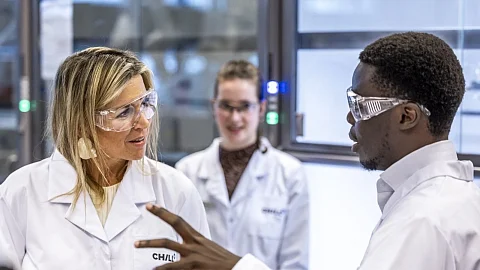
Alkyl Recycling has set up its equipment there to practically test the chemicals on diapers from local daycare centers and incontinence diapers from nursing homes in Maastricht. ‘With these experiments, we have shown that the chemistry we developed in the lab also works in practice with larger quantities of diapers,’ says Kizito.
Now it is time to scale up the innovation. ‘Our goal is to build a factory that can process and recycle one ton of diapers per day,’ he says. The first step for such a factory will be taken at the end of this year. It could recycle hundreds of kilograms of diapers per day within two years.
How to recycle disposable diapers filled with poop, urine, and pathogens?
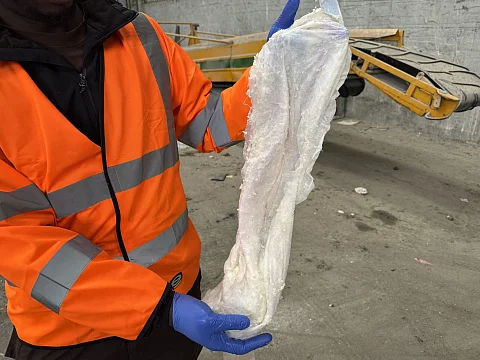
Used diapers are quite contaminated. They are filled with feces and urine, along with pharmaceutical residues, bacteria, and other pathogens. Recycling them requires three steps. First, the feces and urine must be removed and cleaned. ‘That is a difficult chemical process because cleaning super-absorbing material is very complicated. Our process is very effective in that,’ Kizito explains.
In the second step, the diapers need to be sterilized, which means killing the bacteria and pathogens and removing the pharmaceutical residues. ‘This is crucial, as there are very strict regulations in the Netherlands regarding this. The material you sell on the market must be safe. Our technology meets the detection threshold of the RIVM and complies with those standards,’ he explains.
In the third phase, the material needs to be separated. Alkyl Recycling extracts the plastic, cellulose, and gel from the diapers. This must be done in usable quantities of good quality. The startup can recycle about 85 percent of all the material in the diaper. ‘It is simple to describe, but it is a very difficult chemical and mechanical process,’ states Kizito.
According to him, the entire process is sustainable because it requires little energy and emits hardly any CO2. ‘This makes it economically viable. Excessive energy consumption would make it too expensive,’ he says.
1 billion diapers thrown away each year
Globally, 250 million diapers are used and thrown away daily. In other countries, they are dumped in landfills; in the Netherlands, they are incinerated in waste ovens. The Dutch use a staggering 1 billion disposable diapers each year, resulting in 150,000 to 200,000 tons of waste annually.
Kizito came up with the idea of recycling diapers in 2019 while studying at the University of Nairobi in Kenya. He saw how many diapers his aunt used daily for his newborn niece and then threw away. Because waste collection in Kenya is not as efficient as it is in the Netherlands, those diapers end up scattered everywhere on the streets, with all the consequences that entails.
Together with two fellow students, he developed a chemical process to separate the components of diapers for reuse. They founded a company, won awards with it, but could not make further progress in Kenya.
Better facilities in the Netherlands
Kizito was the only one brave enough to take the technology to the Netherlands and set up a new company there. With a startup visa, he ended up at the Brightlands Chemelot Campus in Geleen, where he founded Alkyl Recycling. ‘You need facilities, like a high-tech lab, a lot of experts, and funding. You have much more of that here in the Netherlands than in Kenya. Still, we need many investors. It is a struggle we are fighting to bring this technology to life. But if the market wants it, it will succeed,’ he says.
Two years ago, the startup received an early-stage loan from LIOF, the regional development agency of the Province of Limburg. Shortly thereafter, he was allowed to demonstrate his technology to Queen Maxima. Earlier that year, the SBS6 program Doe Maar Duurzaam featured a segment about his invention.
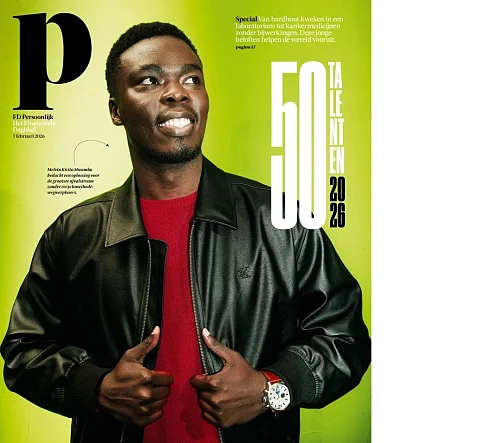
At the beginning of this year, he was interviewed by FD for a special magazine featuring 50 talents for 2026. Kizito even graced the cover. ‘After that, I received a lot of responses from curious officials, investors, and people in the chemical industry. The number of interactions on my LinkedIn account grew by 200,000 percent,’ he laughs.
Investors needed for pilot factory
In December last year, the startup received an EU subsidy of €1.7 million from the Just Transition Fund. To launch the pilot factory, a similar amount in additional investments is needed. LIOF is willing to cooperate in the follow-up financing, and Kizito is currently in talks with other investors. The design for the construction should begin in November or December. Eighteen months later, the first diapers should be recycled. In three years, the factory should be expanded to process one ton of diapers per day.
There are enough potential customers for this material. The cellulose fibers can be reused for the production of paper, cardboard, textiles, or building materials, or as raw materials for biobased plastic. The recycled plastic can be used in plastic mixtures such as polypropylene and polyethylene for new plastic. The super-absorbing gel can be used in the production of cement, adhesives, or coatings.
However, the recycling industry is currently not particularly enthusiastic. It is going through a difficult phase in the Netherlands. Therefore, the startup is focusing on another group of customers. Disposable diapers represent a huge waste problem in healthcare. Almost half of all waste in nursing homes and hospitals consists of incontinence diapers. ‘If we recycle that waste, we help healthcare achieve their sustainability goals,’ says Kizito.
Bringing the product to market with the help of the Green Chemistry Accelerator
Alkyl Recycling is one of the participants in the Green Chemistry Accelerator (GCA) of the Green Chemistry New Economy platform (GCNE) this year. This program was set up alongside Invest-NL and the Regional Development Agencies (ROMs) to help startups and scale-ups scale their innovation, seek investors, and build demo factories. This removes barriers and allows them to enter the market sooner.
During the GCA, each participant works with experts and partners on a concrete plan for approximately 200 days. This examines what the main goals are to be achieved, whether there is demand and customers for the product, and if the business case holds. This is essential for attracting investors.
‘At first, I didn’t know if this program would be useful, but I learned something new about chemical startups in every session,’ Kizito shares. ‘We had to learn who our customers are. Who is willing to pay for our product? Now we have found our customers in healthcare. They are willing to pay for solving their waste problem.’
Customers found for recycled materials
Kizito initially thought he would find his customers in the waste and recycling sector. That turned out not to be the case. ‘Maybe in the future, but not now,’ he states. Despite that, he has found customers who want to purchase the recycled products. Several companies manufacturing insulation materials from newspaper pulp want to use cellulose as an alternative.
The startup is also in talks with companies extracting sugars from cellulose to create feedstock for chemical products. For the plastic, Alkyl Recycling is in discussions with a company that also recycles polypropylene and polyethylene. ‘They are making suitcases, bottles, and a whole range of products from it,’ Kizito notes. Another interested company produces plastic pellets for new plastic.
The market for recycled gel is still young. ‘That super-absorbing material has never been recycled and brought to market,’ he says. ‘But what we have recovered in the lab is of very high quality. If the price is competitive with fossil materials, we can bring it to market. That’s why we need scale.’
Pilot with separate collection of diapers
With waste company RWM, Alkyl Recycling is exploring a possible collaboration in a pilot project aimed at proving that the logistics for the collection and recycling of diapers can work. ‘This will demonstrate to investors how we can collect this waste separately. Then it becomes an interesting business case,’ says Kizito.
During the GCA program, he also realized that Alkyl Recycling should not build large factories itself to recycle diapers. Instead, the startup wants to license its technology to large waste companies. That will be the next step. ‘Then they can adopt our recycling systems. But before we get there, we need to prove that our technology works, what the yield is, and that the recycled products are of high quality.’