
Critical Chemicals Alliance – Europe Embraces a Chemical Industry Facing Major Competitive Disadvantages**
09-10-2026
When a factory closes, more than production capacity is lost. Knowledge, jobs, infrastructure, and connections with suppliers and customers can disappear too. At the same time, investment is needed in new processes and feedstocks to keep European chemistry competitive over the long term. Continuing to use oil as a fuel and as a feedstock for plastics—as oil-producing countries are likely to do—is not an option for Europe. This is not only because of climate concerns or the need for strategic independence, but also because Europe cannot compete with facilities in those countries, which are often newer and larger and are expected to benefit from particularly competitive oil supply prices. The course must change, and the need is urgent!
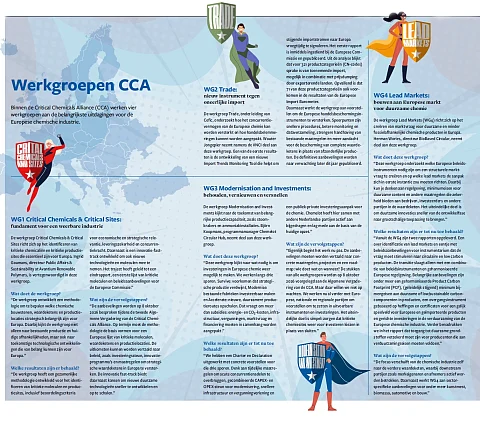
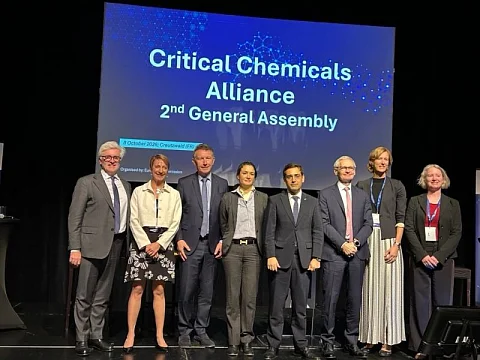
These two challenges came together at the General Assembly of the Critical Chemicals Alliance (CCA). The alliance brings together the European Commission, member states, regions, industry, and other stakeholders. Over the past six months, four working groups have developed proposals on critical chemical production, trade protection, modernisation, and stimulating demand for sustainable products.
At the meeting, the documents prepared by all four working groups were adopted by a majority of more than two-thirds. This provides a common basis for further European policymaking. That basis must now be translated into legislation. The next question is what companies will experience in practice, and when.
Existing and new chemistry at the same site
For GCNE, this starts with connecting existing production to new sustainable pathways. At chemical sites, companies share infrastructure, permits, expertise, and facilities. What happens at one company affects the others.
Modernising this industrial base and developing new production routes must therefore go hand in hand. The CCA is focused on sustainability. In the next phase, GCNE wants modernisation and defossilisation, on the one hand, and new production routes, on the other, to receive equal and systematic attention. This will help secure short-term competitiveness and a distinctive chemical industry based on European feedstocks over the long term. There must also be room for innovation when determining which chemicals and production sites are critical to Europe. An initial list of 50 molecules vital to Europe has been published. This first list is not the end of the process. The methodology behind it is important and will leave room for new molecules that prove indispensable to Europe in the future.
Show where investment is getting stuck
Modernisation requires concrete projects. At the meeting, companies were invited to submit specific examples. Which new production pathway do they want to develop? Where are investments getting stuck? And what support could help reduce the risks?
This makes the discussion practical. A company may have a promising process, but still lack sufficient certainty about costs, sales, or financing to build a plant. Concrete case studies can make it clearer where policy can make a difference.
Governments cannot take on all business risks. But they can work with companies to identify the barriers holding back investment and determine which instruments are appropriate. For GCNE, this is relevant to businesses seeking to scale up biobased, recycled, and CO₂-based feedstocks to industrial levels.
Who will buy the sustainable product?
A new factory also needs customers. That is why demand creation is an important part of the CCA: how can a market be developed in which buyers choose sustainable chemical products? Various models for stimulating the market have been developed, but they still need to be further refined and tested.
How can products’ climate footprints (PCF, or product carbon footprints) be compared? How can the use of circular feedstocks in large-scale production be demonstrated (mass balancing)? And what do European origin and circularity mean for the price a buyer is willing to pay?
Producers cannot answer these questions alone. Brands, processors, and other buyers also need to be more actively involved. Their choices help determine whether a new product can find a market and whether an investment is viable.
This aligns with GCNE’s work within the Demand Creation Coalition. Predictable demand and a level playing field help companies move from technology development to commercial production.
Practical examples for the next phase
The CCA will remain a sounding board for the European Commission. Trade protection needs further development, modernisation projects need to become more concrete, and the instruments for demand creation require further refinement.
GCNE wants to inform this next phase with practical, real-world knowledge. Which projects are ready to scale up? Which offtake agreements are still missing? And where could collaboration within a chemical cluster make an investment possible?
Partners with examples or challenges can share them with their GCNE contact person. This will help connect the European policy agenda with the companies tasked with delivering the feedstock transition.