
Transition to Circularity: 450 Professionals Take the Next Step Together Toward Scaling Up Circularity
30-10-2026
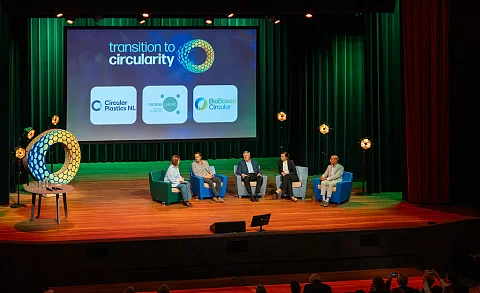
Turning a successful innovation into a successful market application takes more than technology. How do you find buyers? How do you secure financing? And how can you ensure that every link in the chain can grow along with it? At Transition to Circularity, organized by BioBased Circular, Circular Plastics NL and Groene Chemie, Nieuwe Economie, participants discussed what companies need to move forward and how they can work together to overcome obstacles.
European plans for a stronger market
Sylvie Lemoine, Deputy Director General of Cefic, opened the event with a keynote on European plans for green chemistry, bio-based materials and recycling. She explained how the Industrial Accelerator Act, the EU Biotech Act II and the Circular Economy Act aim to strengthen the market for circular solutions. Topics included public procurement, promoting bio-based applications and making it easier to recycle materials that are legally classified as waste.
Karlo van Dam, Director of Sustainability, and Marieke Spijkerboer, Director of Circularity at the Ministry of Economic Affairs, provided an update on the national government's plans. They stressed that circularity is also geopolitically important: a circular economy contributes to a resilient society that is less dependent on external raw materials.
Circularity as part of financing
The financial sector is also looking to take action. Hilde Sijbring, Senior Policy Adviser for the Circular Economy at the Dutch Banking Association, said that the Dutch banking sector aims to incorporate circularity into investment decisions across the board by 2030. This could create more scope for financing circular businesses and projects. Consistent criteria for assessing the sustainability of business plans are essential to achieving this.
Businesses are making progress
Appropriate regulation and greater access to financing are crucial for the next steps in scaling up, as is sufficient demand for products and materials. Thor Tummers of Unilever, Thijs Huijsmans of Heijmans and Lou Schreurs of Harman showed how their companies are moving forward. Tummers said: “We need to work on ‘raising the floor and lifting the ceiling’. Raising the floor is the government’s responsibility, through regulation. Lifting the ceiling is up to businesses. We need to work together across the value chain—and with competitors.”
Zwolle: a hotspot for circular business
After the previous edition in Eindhoven, choosing Zwolle as this year’s venue was no coincidence. The region stands out for its strong network of innovative manufacturing companies, entrepreneurial start-ups and knowledge institutions working together on circular solutions. Through initiatives such as Dutch Circular Polymer Valley, ZWINC and Perron038, the region demonstrates how entrepreneurship, knowledge-sharing and collaboration lead to tangible innovations and new circular businesses. Here, the circular transition is not just discussed—it is put into practice.
New connections, tangible opportunities
Alongside the presentations, there was plenty of opportunity to meet potential buyers, financiers and value-chain partners. Participants explored how they could support one another and what is needed to apply bio-based materials, circular plastics and green chemistry on a larger scale. The willingness to make connections and work together on solutions brought energy to the day.
Through Transition to Circularity, BioBased Circular, Circular Plastics NL and Groene Chemie, Nieuwe Economie are joining forces to build a sustainable, circular industry. By bringing the right parties together, they help turn promising innovations into commercial applications and enable production at greater scale.
The presentations will be published soon on the Transition to Circularity website.