
Green Chemistry Accelerator – A Tailor-Made Venture Program for Dutch Green Chemistry
16-11-2026
Without a clear view of potential customers, there is no investment case. Without financing, the first factories cannot get off the ground. That is why Groene Chemie, Nieuwe Economie (GCNE) brings market development and financing together through the GCA. This tailored programme, set up with Invest-NL, the regional development agencies (ROMs), Gritd and ScaleUp Practitioners, connects entrepreneurs with experts, financiers and other companies facing similar decisions.

From deep dive to implementation
The GCA starts with an analysis of the company and its main growth challenge: the deep dive. A company preparing its first pilot plant will have different questions from a team that is already in business. Together with the entrepreneurs, the programme turns that analysis into a development plan lasting around 200 days. The teams set a goal and measurable results. The GCA then selects the experts and advisers best suited to their needs.
From September through March, participants worked on questions from their plans during in-depth expert sessions. Which application offers the best chance of securing a first customer? What does a pilot installation need to demonstrate? And what information do investors need to make a decision? At the same time, the entrepreneurs put their plans into practice—for example, by talking to potential customers, developing a partnership or preparing a funding round.
Customers took centre stage at the 24-hour session
In June, participants came together for a 24-hour session on their route to market. A discussion paper by Gritd and ScaleUp Practitioners, commissioned by GCNE, and several teaching cases provided the starting point. The journey from pilot to demonstration plant to commercial factory can take years and requires substantial capital. What steps can you take along the way to test whether customers are willing to buy your product?
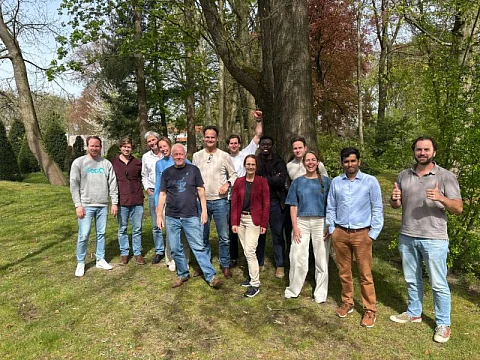
For example, the entrepreneurs explored whether they could start in a niche market with a first paying customer, or develop an application together with a value-chain partner. Early conversations with potential customers provide insight into the required quality, price and volumes. This information helps entrepreneurs substantiate their production plans and makes discussions with financiers more concrete.
What the four participants gained from the programme
For FoamBloxx, which makes plastic foam using at least 50 per cent bio-based or recycled raw materials, the value lay in access to specialists and open exchanges with other entrepreneurs. Those conversations provided a sounding board for a company that wants to expand production in Lelystad and is working towards its first commercial factory. Founder Suzanne Berghuis describes that openness: “You’re in an environment where you can discuss anything, including what isn’t going well. That way, you can learn from each other.”
The programme came at the right time for Back to Battery, as the company began making its first products from metals recovered from discarded batteries. CEO and co-founder Steven Lans says: “The programme came at just the right time for us, because we were just starting to make all those products, and customer contact was becoming increasingly important.” The GCA helped the team clarify the commercial steps involved. The first material samples offered a way to gather feedback while preparations for larger-scale production were still under way.
For Phoenix Metals, the focus was on scaling up the process and communicating with investors. At a pilot plant in IJmuiden, the company aims to demonstrate that it can recover, among other things, vanadium from steel slag on a larger scale. The experts helped the team define its goals for this next step more clearly. CEO and co-founder Gijsbert Bakker says: “Our challenge is to scale up the process and strengthen our communication with investors. This helps with that.”
For Alkyl Recycling, the company’s understanding of its customer changed. It recovers plastic, cellulose and gel from used nappies. Founder Melvin Kizito initially focused mainly on the waste and recycling sector. During the programme, he gained a clearer picture of who is willing to pay for waste processing. “We’ve now found our customers in healthcare. They are willing to pay to solve their waste problem.” The company is seeking separate buyers for the recovered materials. Once the process and material quality have been demonstrated at a larger scale, Alkyl Recycling plans to license its technology to waste companies.
From proven demand to a financeable factory
The closer a company gets to commercial production, the more specific financiers’ questions become. Does the process work at a larger scale? Is the supply of raw materials secured? And who will buy the product, in what volumes and at what price? The GCA helps entrepreneurs turn these questions into a well-supported investment proposal. Through the ROMs, they are connected with financiers suited to their stage of development.
Phoenix Metals shows how public funding and private capital can follow one another. The company received €5 million in grants for research and development. The pilot plant was then backed by €4 million from InnovationQuarter, ROM InWest and private investor Mossinkoff Investments. Alkyl Recycling previously received an early-stage loan from LIOF and a grant from the European Just Transition Fund. The company is seeking additional investment for its pilot plant.
Within GCNE, ROM-Nederland, Invest-NL and 25 public and private financing partners are working together to create this financing relay. By discussing successive funding rounds as part of a connected process, entrepreneurs and financiers can determine during the pilot stage what technical and commercial evidence will be needed to finance a demonstration plant or first commercial factory later on.
What round four shows about scaling up in the Netherlands
For policymakers, the four companies show where public instruments and private capital can complement each other, and how important it is to bring potential customers to the table early. That is why GCNE is involving retailers and major brands more actively in building value chains. Their requirements and expected volumes help entrepreneurs substantiate market demand. The financing relay helps align investments across successive stages of development. The cases also show where Dutch and European instruments can help stimulate demand or enable the next investment. Within the community, entrepreneurs, financiers and value-chain partners share these experiences with companies facing similar decisions.
Are you working on an innovation in green chemistry and looking to find your first customers, prepare a pilot or support your next funding round? Find out more about the Green Chemistry Accelerator.
The Green Chemistry Accelerator (GCA) programme was developed in collaboration with:
- Groene Chemie, Nieuwe Economie (GCNE)
- ROM-Nederland, including ROM InWest, Brabant Development Agency (BOM), Impuls Zeeland, InnovationQuarter, NV NOM, LIOF, Oost NL and Horizon Flevoland
- Invest-NL
- ScaleUp Practitioners
- Gritd