
Rodenburg: Drives Transition to Green and Biobased Chemistry
10-12-2025
Rodenburg has been producing bioplastics from potato starch for 25 years, supplying major clients like Mars, as well as festivals and mussel beds. With its subsidiary Tony Starch, the company will also manufacture chemicals for hundreds of products that currently rely on oil, ranging from sanitary pads to bandages. Additionally, the company has plans to construct a large campus for startups and other businesses focused on green, biobased chemistry.
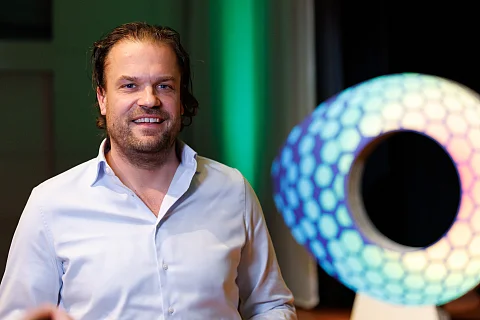
"I dare say that this is the game changer for phasing out fossil resources in chemistry. This is a gigantic market of over a million tons of product per year," says CEO Thijs Rodenburg of the family business based in Oosterhout, Brabant. He is referring to DAS (dialdehyde starch), a molecule derived from starch that has been researched for eighty years but has never been commercially produced. Rodenburg has developed a patented production technology through its subsidiary Tony Starch to manufacture DAS on a large scale. "More than four hundred applications have already been developed for this," says the CEO.
DAS can serve as an alternative to various oil-based chemicals and raw materials that may be polluting or dangerous and are used in various personal care, pharmaceutical, or other chemical products. These range from raw materials for leather to paint, from sanitary napkins and diapers to tissues for blowing your nose, from band-aids to wet wipes. It can also be used for coatings of seeds or fertilizers.
Pilot plant and demo plant
DAS is recyclable and biodegradable, made from starch and green electricity. This starch comes from potatoes, just like the bioplastics that Rodenburg produces, but it can also be made from waste from tapioca, peas, wheat, or corn. The English word for starch is "starch," hence the company name Tony Starch. "Many parties have experimented with DAS on a lab scale and created products from it. But no one has managed to produce it on a large commercial scale yet," Rodenburg explains.
An important aspect of DAS is that it can be just as expensive as its fossil alternative. Consumers are not willing to pay more for greener products, according to the company's experience. In January, Tony Starch will increase the capacity of its pilot plant on the company site in Oosterhout to 50 kilograms of DAS per day. The company already has customers eagerly awaiting this. At the same time, Rodenburg is seeking funding of 50 to 60 million euros for the demo plant, which is to produce 10 tons per day by 2027. Ultimately, a commercial plant is expected to produce 200 tons per day, approximately 60,000 tons per year, after 2030. Additionally, customers who need larger quantities can produce DAS under license.
Side Stream Innovation Valley
Currently, Rodenburg is significantly expanding on his company site. New silos and facilities are being built to process and store starch and products. Besides the new campus for Tony Starch, the company aims to build a larger campus on a meadow next to the forest, fully focused on companies in the green, plant-based chemistry sector.
The working name for this is Side Stream Innovation Valley (SSIV). The campus is comparable to the Brightlands Chemelot Campus for innovation in chemistry in Limburg or the Brainport Industries Campus (BIC) for high-tech manufacturing in Eindhoven. The campus in Oosterhout will feature 65,000 square meters of production halls and 7,000 square meters of laboratories, offices, and other spaces.
Matching Eindhoven's success
It is set to become a Silicon Valley for biobased chemistry. "We want to create a cluster of startups and scale-ups that are complementary to each other, processing plant-based raw materials into new materials. We see synergy advantages when everyone is located in one place," explains Rodenburg. "The BIC is creating enormous success in Eindhoven. We want to achieve the same here with plant-based materials."
Rodenburg has already made contacts with universities, colleges, and WUR in Wageningen. Companies are also inquiring daily for a spot. "We are being overwhelmed by parties wanting to be here—both from the Netherlands and abroad," says Rodenburg. "There is plenty of demand. The only problem is a shortage of space in this region."
The municipal council of Oosterhout has already approved the plan and amended the zoning plan. Local environmental organizations have raised objections against this, and the Council of State will rule on it next year.
First bioplastic factory produced no plastic
Thijs Rodenburg is the third generation to head the eighty-year-old family business. His grandfather made animal feed from potato starch, waste from large chip and fries factories, which was then simply dumped into the sea. In the 1990s, his father began researching what else could be done with it. Together with Wageningen University (WUR), he aimed to develop bioplastic from it.
While startups are currently struggling to introduce various technologies for plant-based chemicals and plastics, and flagship Avantium is starting its first factory for 5,000 tons of plant-based PET bottle alternative PEF after 25 years, his father had already built a bioplastic factory with a capacity of 20,000 tons in 2000. That factory is still operational.
What did that factory produce? "No bioplastic," Rodenburg says. "My father was a firm believer, but there was no market for biobased, biodegradable plastic at that time. Meanwhile, we had a shiny new factory built at a god-awful cost. We went through some pretty tough years back then."
Sustainability was not yet an issue. Boyan Slat had not yet begun his fight against plastic waste in the oceans. Furthermore, biobased biodegradable plastic – just like now – was more expensive than fossil plastic. Customers were skeptical and had to be convinced that the material could work in their machines, and they saw no consumer market. Consumers were not willing to pay more for green products, referred to as the green premium. The profitable animal feed branch – which has since been sold – kept the company afloat during that time.
Biodegradable materials for earthworks and horticulture
Afterwards, Rodenburg explored what else could be made in that factory. Ingredients for paper or wood glue emerged, for pots and plant ties for horticulture, for stakes and geo-textile mats for earthworks and construction. All made from potato starch and compostable or biodegradable if desired, which is important for use in nature or at sea.
This material is used, among other things, in the restoration of coral reefs and mussel beds. "This is the cork that the company revolves around. The bioplastics still aren't performing as we'd like. It's still a difficult product. You need to identify the right niche markets," Rodenburg states.
Biodegradable wrappers for Mars
Nevertheless, the company has striking examples of well-known clients and applications in that area. For the plastic wrappers of Mars, Twix, and Snickers, Rodenburg developed a food-safe, biodegradable alternative in 2016 together with partners using his own innovative material, Solanyl. "We are very proud of that. It went very well, but ultimately Mars found it too expensive. So now, unfortunately, it is no longer on the market," Rodenburg laments.
Other applications of the bioplastic include biobased, recyclable displays and tokens for festivals, containers and cups – including for a well-known airline – products for farmers and gardeners, pens, bags, USB sticks, and promotional materials. "Most products can be shredded after use to create new plastic," he explains.
This article was previously published in Change Inc, by editor André Oerlemans.