
FoamBloxx is Taking the Market by Storm with Plant-Based and Recycled Foam
08-10-2026
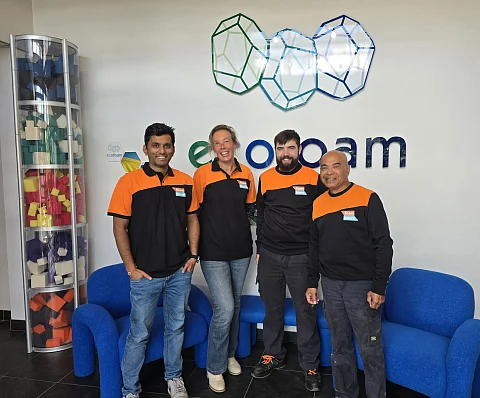
The foam market is quite conventional and is only slowly moving towards sustainability. ‘We want to disrupt the entire market and show as a frontrunner: just join in. Really incorporate green materials and let’s make the whole market sustainable. That is our sincere goal,’ says Suzanne Berghuis, founder and director of FoamBloxx. ‘We are too small to do this alone and therefore we want to involve all other foam producers, as well as customers and suppliers in this.’
100 percent not yet achievable
The startup is setting a good example by ensuring that its plastic foams are made from 50 percent bio-based or recycled raw materials. Only when the minimum threshold of 50 percent is reached is it classified as ecologically produced foam: ECOfoam. ‘100 percent is our goal, but unfortunately that is not yet possible,’ says Berghuis.
‘If it were, the foam wouldn't form as needed. You need raw materials that combine to create the foam, and currently, fossil chemicals are still required for which there are no alternatives yet. Or it gets too expensive. We are continuously innovating to increase that percentage as high as possible. We could already go higher, but customers are not quite willing to pay for it yet, so we cater to the customers. If we have customers that want a higher percentage and are willing to pay for it, then we already have that possibility. We make custom solutions.’
Leading in sustainability
FoamBloxx is a spin-off of the family business Uxem, which celebrates its 52nd anniversary this year. When her father and founder Allard Berghuis, who passed away earlier this year, moved the company to Lelystad in the early 2000s, he already recognized the urgency of making foam in a more sustainable way. At that time, the industry primarily focused on the use of alternative blowing agents for CFCs, which cause ozone layer depletion, and HFCs, which warm the climate. Those are now banned.
Uxem primarily purchased foam to process, but her father wanted to develop it himself. ‘He was far ahead in terms of sustainability and wanted to produce foam without blowing agents,’ his daughter recounts. ‘He secured the first innovation subsidy from Flevoland and just got started.’
Senior Berghuis developed his own machine based on a vacuum process, proving that it was possible to create foam without blowing agents.
ECOfoam branch spun off from parent company
He also began developing an innovative, sustainable foam called ECOfoam in 2007, not yet with a commercial focus. The goal was that at least half of the raw materials for that foam would come from nature. It took years to achieve this.
When Suzanne Berghuis took over the company sixteen years ago, she aimed to further enhance sustainability and continued this development. In 2024, the ECOfoam division will be split off as FoamBloxx. ‘This way, the companies can grow separately. In a long-established company like Uxem, the atmosphere is different than in a startup, where the mindset revolves around sustainability, innovation, and making an impact,’ she explains. ‘FoamBloxx could also become very large. That involves different investors, different customers, even competitors of Uxem. Therefore, you need to be independent from each other.’
High demand for recycled foam
Producing polyurethane (PU) foam from plant-based or recycled raw materials is not simple, as Berghuis has learned over the past years. ‘We’ve tried at least a hundred different options. That ranges from vegetable oils to very unusual raw materials. You can’t just process those raw materials from nature into foam because they won’t perform adequately. You need to convert them into a bio-polyol. We do that conversion process in-house, and in that respect, we are unique. We are truly practicing green chemistry.’
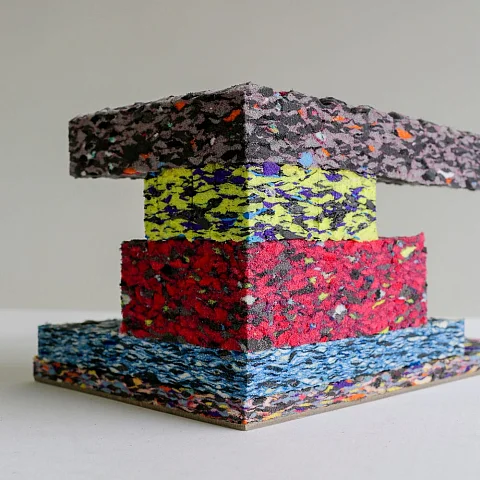
Additionally, she has a strong preference for recycled raw materials. ‘That’s why we focus on both,’ she says. ‘So we not only use bio-based, but also recycled raw materials. For instance, mattresses are recycled into a polyol, which we can then use in our foam. Furthermore, we make 100 percent recycled foam from any remains returned or leftover from the ECOfoam. We call that ECO rebonded foam. There is currently a high demand for it because various industries are searching for sustainable alternatives to foam. The demand exceeds our capacity, which is why we must scale quickly.’
Scaling up with a new demo factory
In its scaling efforts, FoamBloxx is outpacing traditional startups. It has benefited for years from the facilities, experience, and scale of Uxem, with which it still works closely. ‘It takes years to innovate and set this up, and we have already made ample use of that,’ says Berghuis.
The parent company was the first customer, tested FoamBloxx's sustainable foam blocks, and provided feedback until they were optimized. The first pilot factory could be built within Uxem, and the scaling of the demo factory is also taking place within the familiar walls in Lelystad. ‘We are currently renting two halls from the Uxem premises. We are building a second machine there that can handle three to four times the capacity,’ she explains. ‘Construction starts in October, and it should be operational by mid-2027.’
The capacity of such a factory is measured in tons, but when it comes to foam, that’s not as substantial. ‘It always sounds a bit sad what we make because it’s 90 percent air. We are now scaling up to a production of a kiloton per year,’ she explains.
Financing needed for the first commercial factory
For the larger demo factory, FoamBloxx has secured 1.2 million in financing. The next step is to construct a first commercial factory. For this, the startup has already purchased land in Lelystad, adjacent to Uxem. ‘We remain sister companies. We can use Uxem’s waste and Uxem can use our blocks. This also saves transport costs,’ she says.
The construction of this new facility is expected to start in 2027 and be completed in 2028. Several million are needed for this, and the company is still seeking financing.
Clients wanting to lead the way
FoamBloxx's foam is used in various applications, including acoustics and sound insulation, seals, packaging, meeting cubes, children’s play areas, sponges, cleaning products, and various technical applications. ‘Our customers have sustainability as their identity and want to lead in their market,’ says Berghuis.
She also views the packaging market as a potential client. Since August, the EU has implemented the European Packaging and Packaging Waste Regulation (PPWR). This regulation stipulates that packaging must contain a certain percentage of recycled material by 2030. ‘The packaging industry is indeed a sector where you see that customers want this alternative, understand that they may have to pay a bit more, but also realize that they have no choice. We are well-positioned to meet this demand,’ she adds.
Entering the market with the help of Green Chemistry Accelerator
This year, FoamBloxx is one of the participants in the Green Chemistry Accelerator (GCA) of the Green Chemistry New Economy (GCNE) platform. This program was set up alongside Invest-NL and the Regional Development Agencies (ROMs) to assist startups and scale-ups in scaling their innovation, seeking investors, and building demo factories. This helps remove barriers and allows them to enter the market sooner.
During GCA, each participant works with experts and partners on a concrete plan for approximately 200 days. It assesses the primary goals to achieve, whether there is demand and customers for the product, and if the business case makes sense. This is essential for attracting investors.
Unique network of experts
Berghuis describes the program as ‘valuable and inspiring. You are in an environment where you discuss everything openly, even what is not going well. This allows you to learn from each other. It’s really a kind of growth accelerator.’
In particular, the connections with other startups motivate her. ‘It’s quite special that they bring us together in this process,’ she says. ‘Green chemistry is very broad, and most companies know they have to navigate this as a startup alone. Here, you have access to a network of experts that helps you make a breakthrough. Each participant brings something to the table. I, for example, have a bit more entrepreneurial experience and may be a bit more realistic.’
The GCA program strongly emphasizes finding customers and establishing viable business cases. Unlike other participating startups, FoamBloxx is already quite advanced in this area. Berghuis states, ‘We started this innovation back in 2007 and have already achieved milestones in the pilot phase. We could grow within the family business, where there was room for innovation. We already have many customers, but they sometimes still find it a bit expensive. The challenge is: how do we find customers willing to pay more for sustainability? These kinds of initiatives are never cheaper. A bio-tomato is also never cheaper. Therefore, it helps when there is more regulation. That customers must become sustainable, and that cheaper alternatives from China do not creep in.’