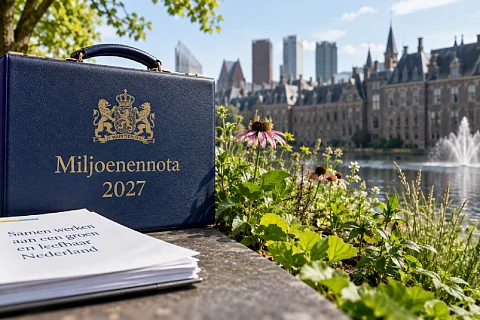
Budget Memorandum 2027: Extra Attention for Circular Economy, But Where Does the Money Land?
16-09-2026
Budget Memorandum 2027 confirms that the cabinet wants to emphasize the circular economy as part of the future earning capacity of the Netherlands. At the same time, the concrete financial translation of this ambition is still limited in some areas. Three developments are particularly relevant for green chemistry and the circular industry: funding for the circular economy within the budget for Climate and Green Growth (KGG), the further budgetary trajectory of the NGF program Biobased Circular, and a new opening of the National Growth Fund for strategic industrial policy.
Funding for the Circular Economy: Focus Shifts to Implementation and Scaling Up
The government aims to strengthen the National Program for Circular Economy (NPCE) by 2027. While recent years have heavily focused on policy development and goal-setting, the emphasis is now shifting towards practical implementation and scaling up. The government seeks to eliminate obstacles and make circular business models more competitive, providing companies with greater certainty and room for investment. Priority sectors include circular construction, green chemistry, and electronics. Additionally, the government wants to leverage its procurement power more effectively as a 'launching customer'.
Notably, responsibility for the circular economy is being transferred more explicitly to the Ministry of Infrastructure and Water Management (IenW) starting this budget period. Budgets for the circular economy are being reallocated from IenW to the Ministry of KGG. This move strengthens the connection between the circular economy and broader climate, energy, and industrial policies. However, the budget still lacks clarity on which amounts will ultimately go towards which instruments, sectors, or projects. Thus, while the policy ambition is clearer, the financial execution remains less so.
Biobased Circular: Budget Path Extends to 2030
The National Growth Fund program Biobased Circular will remain visible in the budget until 2030. This program focuses on the development of climate-neutral materials and circular biopolyesters as the basis for a new industry, particularly for plastics, polymers, and construction materials. The explicit goal is to ultimately make biobased materials competitive with fossil alternatives in terms of both properties and price.
However, budget figures indicate that the program will follow a declining budget path towards 2030, as the second phase of Biobased Circular has not been granted. The sector is now questioning what public funds will be available and, more importantly, how these resources will be used in the coming years to bring technologies into demonstration, scaling up, and market introduction.
NIKI: €250 Million Allocated for Second Opening
For companies engaged in large-scale industrial sustainability efforts, the National Investment Scheme for Climate Projects in Industry (NIKI) is relevant. This scheme is intended for large CO₂-reducing projects and innovative techniques that do not fit well within existing regulations. Specific examples include electric cracking and green chemistry. In the first round of applications, one positive decision was issued worth €135 million. For a second application round in 2026, about €250 million is allocated, with associated cash expenditures expected to be realized starting in 2027. This makes it one of the most concrete financial instruments in the budget for large-scale innovative industrial sustainability.
National Growth Fund: Freed-Up Resources Redirected to Strategic Industrial Policy
Finally, there is movement within the National Growth Fund. Adjustments to previously awarded projects have freed up resources. The cabinet has chosen not to redistribute these funds to existing projects, but to utilize them for a new round of openings for the National Growth Fund, aimed at strategic industrial policy. In the NGF budget, a total of €229.7 million in expenditures is projected for 2027. For the new application round of the National Growth Fund 'Strategic Industrial Policy', €388.9 million has been included in the budget.
For GCNE, it is significant that the budget document illustrates a clear shift: circular economy, green chemistry, and strategic industrial technology are increasingly becoming part of economic growth policy. However, the next step is crucial: available funds must actually reach the technologies and companies that can transition from innovation to industrial scale. The budget document provides direction but leaves various aspects open regarding how much money will ultimately be available, through which instruments, and over what timeline. This makes the detailed development of budgets and subsidy schemes in the upcoming period at least as important as the budget document itself.
Circular Leverage
There is still no clarity on the deployment of a Circular Leverage to help frontrunners in the circular industry in the Netherlands accelerate scaling up. The Circular Leverage was part of a widely supported package of measures proposed by the Plastic Table one and a half years ago. The Circular Leverage can stimulate market demand for circular materials and aligns well with ongoing European initiatives. Without market demand, there will be no scaling up of innovation, and thus no contribution to the earning capacity of the Netherlands.