
Phoenix Metals Extracts Vanadium from Tata Steel's Steel Slag for Safer Batteries
30-09-2026
The European steel industry generates 16 million tons of steel slag each year, with Tata Steel Netherlands accounting for 650,000 tons of that total. Phoenix Metals can recover important metals such as vanadium, manganese, and carbon-free calcium from this slag. In IJmuiden, the Dutch startup is constructing a pilot factory to demonstrate that this can be done on a large scale.
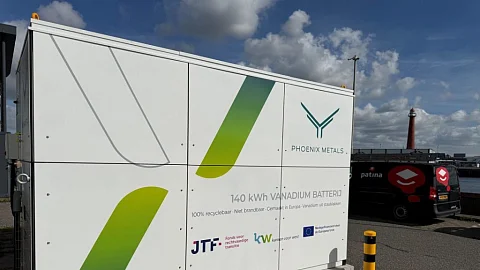
The phoenix is a firebird that rises from its ashes. This is exactly what Phoenix Metals does with the waste from refineries and steel mills: it resurrects raw materials.
Recently, Deputy Secretary Annet Bertram from the Ministry of Infrastructure and Water Management visited the company. She called it "an inspiring behind-the-scenes look at innovation, sustainability, and the future of the metal industry." "It is wonderful to see the interest from the ministry. That they understand what we are doing here. Last year, Secretary of State Thierry Aartsen also visited," says CEO and co-founder Gijsbert Bakker of Phoenix Metals.
Solving the Steel Slag Issue
This demonstrates that there is hope not only from the steel industry but also from the government for the startup. The company can address a significant national and European issue: what to do with steel slag? The European steel industry produces 16 million tons of it each year.
The stony byproduct of steel production has so far mainly been used as fill material in civil engineering projects. However, in recent years, there have been concerns about safety, as hazardous substances from the steel slag can contaminate water and soil. Therefore, Secretary Bertram wants to ban its use unless it can be proven safe.
A company like Tata Steel, which produces 650,000 tons of steel slag annually, has already faced a penalty from the Inspectorate of the Ministry of Infrastructure and Water Management (ILT) because it does not want to classify its slag as hazardous.
Recovering Critical Metals
Phoenix Metals can recover various essential metals from steel slag using chemicals. For example, vanadium, designated by the EU as a critical and strategic raw material. It is used in armor, rebar, nuclear reactors, automobiles, rockets, tools, and batteries. "Vanadium is actually in everything," Bakker notes.
Additionally, steel slag is full of other metals that the startup can recover, such as iron, manganese (also a critical raw material), magnesium, and calcium. All are useful building blocks. This is known as urban mining.
Manganese is reused in steel or batteries. Calcium can be used in cement or steel. Iron can simply go back into the steel furnaces. "We think we can recycle about 80 percent of the steel slag for reuse. Whether it is good or bad, it is a waste to put steel slag underground. It's an underutilization of ore," Bakker argues. "Steel slag contains as much vanadium as vanadium-bearing ore, for example."
Pilot Factory Near Tata Steel
Phoenix Metals has recently entered into a partnership with Tata Steel Netherlands, the major steel producer in IJmuiden. This creates a win-win situation. Tata Steel supplies the steel slag from which the startup extracts the metals. If successful, it helps Tata Netherlands solve an environmental problem. "The Netherlands is a leader in this, but we are also noticing interest from other steel mills in Europe," Bakker says.
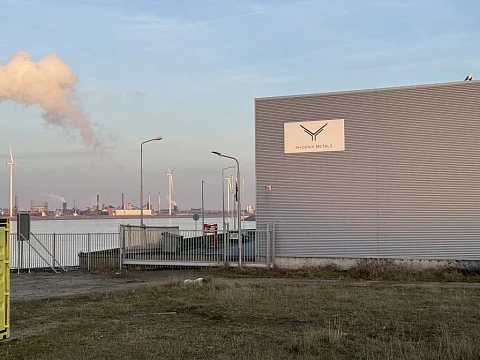
To demonstrate that it is possible to recover metals from steel slag on a large scale, the startup is building a pilot factory in IJmuiden, just a stone's throw from Tata Steel. It is expected to be completed by mid-2027.
Bakker: "You need to demonstrate scale. If the pilot factory can operate every day, it can process 500 tons of steel slag per year. After that, you must establish your first commercial factory as quickly as possible. This should process 100,000 tons per year. Ultimately, we want to expand that to a million tons."
If the pilot factory is successful, the company aims to start building the commercial factory in 2028, which should be operational by 2031.
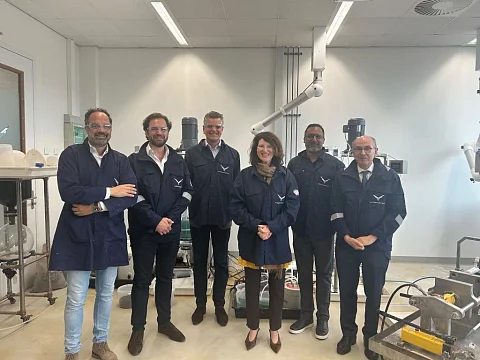
Selling Vanadium to Battery Manufacturers
An important question for an innovative startup is: who is your customer? In the case of Phoenix Metals: to whom do you sell the recovered metals? The startup aims to sell its vanadium to battery manufacturers.
The vanadium battery has existed since 1985, is a proven technology, and offers an alternative to the lithium-ion battery. While the latter can sometimes catch fire, the vanadium battery is non-flammable. Hence, it is often used in data centers. Additionally, it has a much longer lifespan than a lithium-ion battery. The third advantage is that vanadium batteries take up less space and can be placed more efficiently in buildings.
"There are already builders of such batteries in Germany, Austria, and Belgium, and now with H2OVolt even in the Netherlands," Bakker states. "The issue with these batteries is the dependence on raw materials. Europe currently imports 95 percent of its vanadium, around 12,000 to 18,000 tons. We could make a difference by recovering vanadium from steel slag. There is so much vanadium in Dutch steel slag that we could supply one-third of the current demand, about 5,000 to 6,000 tons. But to make this a success and compete with imports, you need to operate on a large scale."
Bakker also believes he can find enough buyers for the other metals, although that is not the only market. "Our customer base is actually twofold. Another type of customer consists of the steel mills. We offer them a solution for steel slag processing," he explains.
It All Started in South Africa
The story of Phoenix Metals began years ago in South Africa, where the four founders, as engineers, advised a client who wanted to extract vanadium from ore in a different way. The traditional methods consumed too much energy, which is expensive there. So, they sought an alternative process.
Bakker and his colleagues advocated for hydrometallurgy, a chemical process that allows metals to be extracted from ore using liquids. "This requires less energy because you use chemicals. Instead of temperatures between 1,200 and 1,500 degrees Celsius, you operate below 100 degrees," he explains.
They immersed themselves in the technology, but the client could not finance the project due to other circumstances. Subsequently, another client in the Netherlands asked them to process waste from scrubbers on sea vessels, which clean the exhaust from diesel and fuel oil. They also found vanadium in that waste.
Since 2020, they collaborated with a lab in Delft to explore the possibilities. This partnership ultimately led to the founding of the new startup: Phoenix Metals. Besides recovering metals from scrubber sludge, they have focused on steel slag since 2023.
"In the long run, we would like to address all industrial, metal-containing waste streams, but we had to make a selection," Bakker says. "One of the challenges in green chemistry is the reliable supply of raw materials. The advantage of steel slag is that you have guaranteed volume. All the steel mills in Europe produce a total of 16 million tons of steel slag annually. This is an enormous feedstock for us."
Scaling Up with Subsidies
The hydrometallurgical technologies operate at low temperatures and are therefore relatively sustainable. Bakker states: "Our process is scope 1 emission-free. We only use electricity and burn nothing. The calcium we produce is carbon-free. Normally, you extract calcium from limestone and have to calcine the CO2. That is not necessary here."
Phoenix Metals started in the startup incubator Yes!Delft and subsequently moved to the adjacent laboratory to further test its technology. The R&D phase was financed with 5 million euros in subsidies from the European Just Transition Fund, the provinces of South Holland and North Holland, the Netherlands Enterprise Agency (RVO), and Opportunities for the West.
Now the startup is in the pilot phase and is seeking investors for its pilot factory. Recently, the company received four million euros from two regional development agencies, InnovationQuarter for South Holland and ROM InWest for North Holland, as well as from regional investor and project developer Mossinkoff Investments.
Market Entry with the Help of Green Chemistry Accelerator
Phoenix Metals is one of the participants in the Green Chemistry Accelerator (GCA) program this year, established in collaboration with Invest-NL and regional development agencies (ROMs) to help startups and scale-ups scale their innovations, seek investors, and build demo factories.
This helps remove barriers and enables them to enter the market sooner. During GCA, each participant works with experts and partners on a concrete plan for about 200 days. This plan assesses the key objectives to achieve, whether there is demand and customers for the product, and whether the business case holds up. This is essential to attract investors.
Feedback from Other Startups
Bakker praises the expertise level of the GCA specialists. "They provide advice on scaling up, focusing your company, defining your objectives, and how to achieve them," he says. "For us, the challenge is in scaling up the process and enhancing communication with investors. This program assists with that. It is also valuable that they involve other companies that share their scaling success stories, such as Avantium."
Additionally, he found the interaction with other participants very valuable. "You sometimes feel quite alone as an entrepreneur," he remarks. "The advantage of the program is that you are put together with other entrepreneurs from the same sector. You face similar challenges. They serve as a sounding board."
Article at Change Inc., by André Oerlemans