
GCNE Advocates for Market Creation and Circular Leverage in Discussion with Minister of Climate and Green Growth
17-06-2026
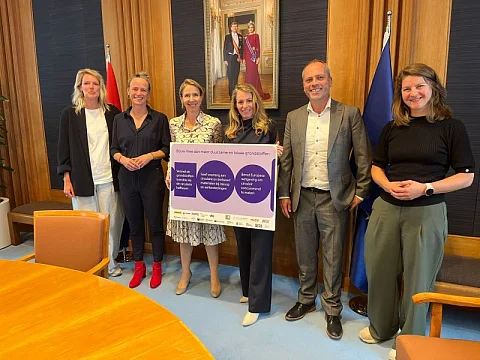
The Hague – Groene Chemie Nieuwe Economie (GCNE) held a discussion with Minister Stientje van Veldhoven of Climate and Green Growth. Together with companies and organizations, including Future Up, Strukton, and Fair Furniture Group, the central question was how the Netherlands can accelerate the market for sustainable and circular raw materials.
Under the name GCNE, Nicole van Klaveren shared the experiences of the game changers working on the new chemistry: innovative companies developing sustainable alternatives to fossil resources and ready to scale up.
"The companies that are working on the new chemistry are ready. What is now needed is market creation. Without demand, there can be no scaling up. That is why we have advocated for the Circular Lever as a tool to make sustainable resources more competitive and to attract investments."
– Nicole van Klaveren, Green Chemistry New Economy
Market Creation as the Key to Scaling Up
During the discussion, it was emphasized that technological innovation alone is not sufficient to accelerate the transition to a circular economy. Sufficient market demand and a level playing field are also essential for large-scale investments.
Moreover, market creation stimulates the development of new value chains. From raw material producers and technology developers to manufacturers, purchasers, and end users: collaboration in the chain is necessary to successfully scale circular materials.
Circular Lever
A key topic during the meeting was the Circular Lever: a fiscal instrument that makes the use of circular and biobased raw materials more attractive compared to fossil alternatives. According to the participating parties, such a measure can contribute to a stronger investment climate for the new chemistry and the development of a competitive circular industry in the Netherlands.
The discussion built on the Resource Transition Manifesto, which was previously presented to the political landscape by twenty companies and organizations. The manifesto calls for stronger positioning of sustainable and locally produced raw materials within Dutch and European industrial policy.
GCNE reflects on a constructive conversation and continues to work, together with entrepreneurs, knowledge institutions, and governments, towards better conditions to help innovative companies successfully transition from technology to market.